
A new report from the National Institute of Public Health [2] provides a useful description of the organization of nutrition and the problems faced by educational institutions (VIZ). However, it does not allow for a comprehensive assessment of the quantitative, energy, and nutritional compliance of meals with the Guidelines. Such an assessment would be very important for evaluating the actual adequacy of nutrition. The report does highlight numerous problems and opportunities for improvement, but less clearly defines which of these should become priorities and how to monitor whether nutrition is actually improving.
Comprehensive professional monitoring of nutrition in educational institutions is the responsibility of NIJZ, and menus are also often assessed by us due to their public accessibility. To make such assessment as objective as possible, in today's article we will show some basic criteria by which we can assess menu compliance with the recommendations from the Guidelines. We will then apply these criteria in practice and look at three publicly published weekly menus – from a kindergarten, primary school, and secondary school – to see how often individual food groups are represented and where potential deviations can be identified from the published menu.
Why is organized nutrition in educational institutions an important public health investment?
According to data from the Statistical Office of the Republic of Slovenia, in the 2025/26 school year, 79,868 children were enrolled in kindergartens, 192,915 students in primary schools, and 86,624 students in secondary schools. Together, this is almost 360,000 children and adolescents, or approximately 17% of all residents of Slovenia [3].
This means that the nutritional environment in educational institutions directly reaches almost every sixth resident of Slovenia – and this during a period when eating habits are still being formed.
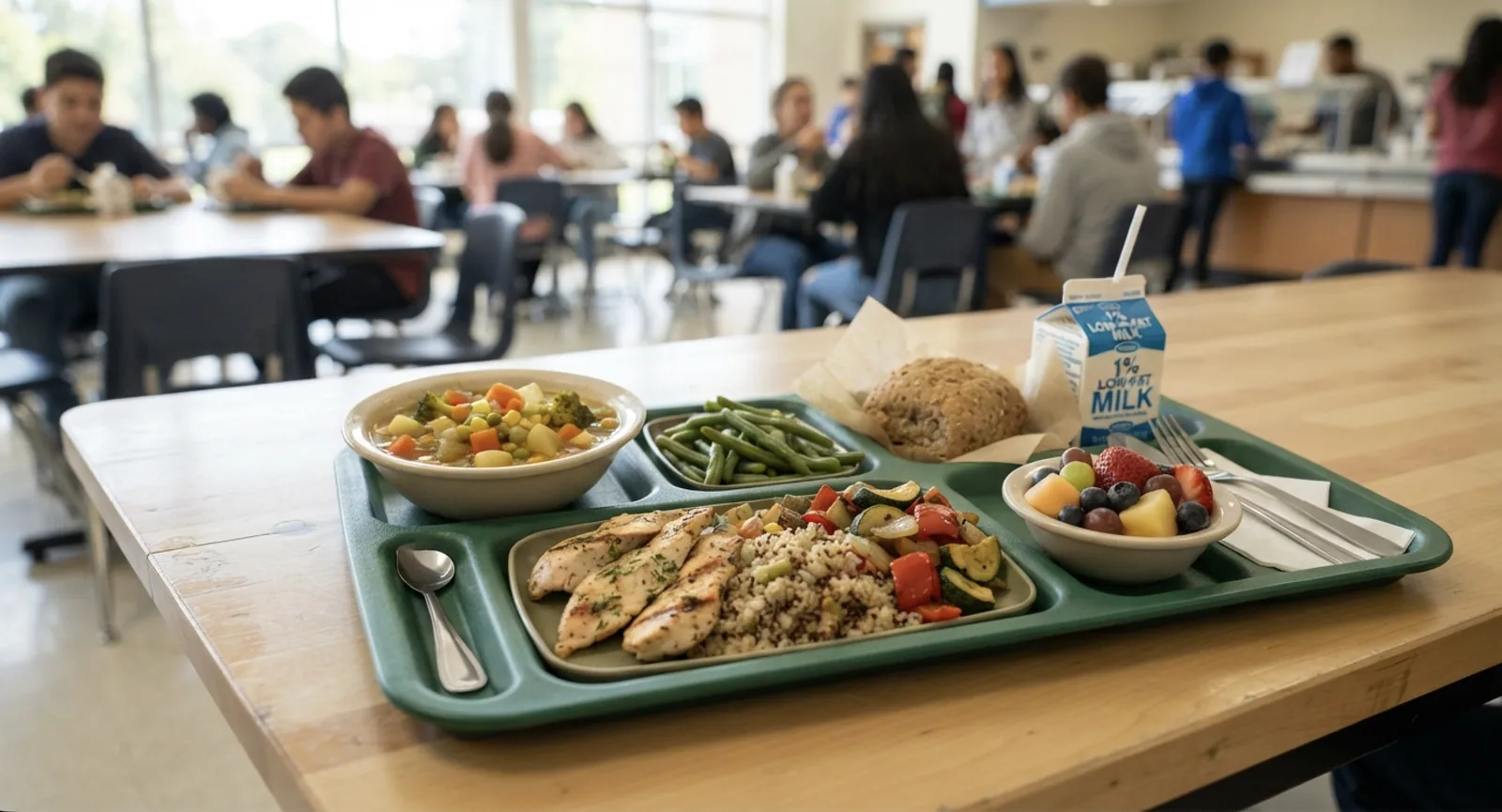
Children and adolescents can consume a significant proportion of their daily energy intake in kindergarten or school. The quality of organized nutrition therefore affects not only a single meal, but also nutritional care, the development of eating habits, and reducing inequalities among children.
That is why the World Health Organization treats the school nutrition environment as an important area of public health policies and emphasizes nutritional standards, direct provision of meals, and measures that enable healthier choices [4].
Slovenia has an important advantage in this regard. The organized nutrition system is already integrated into the educational environment, and institutions must follow the Guidelines for Nutrition in Educational Institutions when organizing nutrition [1]. Since we have invested knowledge, infrastructure, employee work, and public funds into this system, it is reasonable to expect clear monitoring of its results.
How can publicly published menus be assessed more professionally?
With the abundance of information that is publicly accessible today, it would be underestimating to claim that parents or other interested members of the public cannot provide specific comments on publicly published menus. Professional responsibility for nutrition planning lies with the nutrition organizer, but this in itself does not mean that the menu actually follows the Guidelines. It is precisely by consistently following them that we support the child's nutritional needs and the development of healthy eating habits.
So that everyone who monitors nutrition in a particular institution can assess menus on a more professional basis, we highlight some basic criteria from the Guidelines that must be considered. Such an assessment does not replace professional analysis, but when monitoring a menu over a longer period, it can reveal important patterns.
When assessing a menu, we can use some very specific questions:
- Vegetables and fruit: are vegetables and/or fruit included with every meal, with more vegetables?
- Whole grains and cereals: do whole grain bread, whole grain pasta, cereals, oat flakes and similar foods appear regularly?
- Legumes: are they regularly included in the menu, also as a substitute for meat?
- Fish: are fish or fish dishes included weekly or at least every 14 days?
- Meat: does white meat appear more often than red meat and is lean meat primarily chosen?
- Meat products: do lean products with visible meat structure take priority, while other meat products are included only occasionally?
- Sweet dishes and products: do sweet spreads, desserts, sweetened dairy products, sweet cereals and other sweet foods appear only occasionally?
Below we show what such an assessment can look like in practice. Since each case is a one-week excerpt, the assessment does not represent a comprehensive evaluation of the monthly menu, but it can show important patterns and potential deviations from the recommendations.
We will not identify institutions by name; we keep original menus in internal records.
Example 1: Kindergarten
For the kindergarten, we assessed all four meals that, according to the Guidelines, are usually included in organized nutrition: breakfast, morning snack, lunch, and afternoon snack.


Summary:
The weekly review shows low representation of vegetables, legumes, and whole grains, as well as more frequent inclusion of red meat, meat products, and sweet foods.
Example 2: Primary School
In the assessment, we focused on the morning snack and lunch, which are consumed by the most children.


Summary:
The menu is well-composed and diverse. Room for improvement remains mainly in the daily inclusion of fruit and nuts and seeds. Sweet foods are present but do not predominate.
Example 3: Secondary School
For the secondary school, we assessed the snack, which the school must provide to students in accordance with the School Nutrition Act. Since students have several different menus available each day, we considered the entire weekly offering in the assessment.


Summary:
The weekly snack offering at the secondary school shows several significant deviations from the Guidelines' recommendations. There are too few vegetables, fish, legumes, nuts/seeds, and clearly recognizable whole grains, while more processed and sweet foods appear too frequently. The offering is diverse, but not all choices are nutritionally appropriate.
Conclusion
When we talk about children's nutrition in kindergartens and schools, it quickly becomes apparent that expectations are not uniform. Some want more vegetables, legumes, whole grains, and less sweet or highly processed foods, while others place greater emphasis on the child actually eating the meal and not remaining hungry.
That is precisely why planning children's nutrition in educational institutions must be based on professional recommendations, not on individual wishes, opinions, and preferences.
Healthy nutrition for children in educational institutions is part of national public health policy.
That's why we have Guidelines, nutrition organizers, kitchen staff, subsidized school meals, and a professional monitoring system. Discussion about how best to translate recommendations into practice is necessary. However, whether or not children should be provided with nutritionally adequate meals should not be a matter of negotiation.
Organizing nutrition that will please everyone is impossible. Organizing nutrition that is professionally grounded and consistent with the Guidelines is possible. And that is precisely what the nutrition system in educational institutions should consistently ensure.
Would you like to review your institution's menu in more detail?
At HFL Institute, we conduct professional menu reviews and provide advice on aligning them with the Guidelines for Nutrition in Educational Institutions. We will be happy if you contact us.
References
- ZRSŠ, Smernice za prehranjevanje v vzgojno-izobraževalnih zavodih. 2024: Ljubljana.
- Pralica, V., Gregorič, Matej, Strokovno spremljanje prehrane v vzgojno-izobraževalnih zavodih s svetovanjem: Poročilo za leto 2025. 2026, NIJZ: https://nijz.si/wp-content/uploads/2026/08/Porocilo_spremljanje-prehrane-2026_v_koncnov2.pdf.
- SURS. Udeleženci predterciarnega izobraževanja, šolski leti 2025/2026 in 2024/2025. 2026; Available from: https://www.stat.si/StatWeb/news/Index/14313.
- WHO, Policies and interventions to create healthy school food environments: WHO guideline. 2025.