


When we think about our children's future, we most often consider their education, career prospects, independence, and quality of life. We invest in knowledge, activities, and experiences. Less often, however, do we consider how powerfully that future is shaped by nutrition and daily eating patterns.

Eating habits are not innate but develop through interaction with a child's environment. While children are born with some innate responses to flavors, such as greater sensitivity to bitter and very sour tastes, their relationship with food develops through experience. What they regularly taste, what they see adults eating, and what is typical in their environment gradually becomes their way of eating [1].
This is why the early period is so crucial. Long-term population studies show that dietary patterns established in childhood and adolescence often carry into adulthood and significantly influence the likelihood of developing obesity, type 2 diabetes, cardiovascular disease, and even affect cognitive function [2].
The consequences of these diseases don't just affect the individual. These are chronic non-communicable diseases that are the leading cause of premature mortality in the developed world, and unhealthy dietary patterns (often combined with excess body weight) significantly increase the risk of their development. The OECD estimates that diseases related to excess body weight alone account for approximately 8.4% of all healthcare expenditure in member countries and significantly impact economic productivity [3].
Therefore, healthy eating habits in childhood are not just a personal choice. They are a long-term investment in the health, work capacity, and quality of life of future generations.
The Hidden Cost of Unhealthy Eating in Children
The consequences of unhealthy dietary patterns typically don't manifest in childhood but much later. In the early years, the problem often appears mainly as excess body weight or poor physical fitness, while the long-term risk for chronic diseases gradually increases.

Children today grow up in an environment where sugary drinks and snacks are available everywhere and are often cheaper and more accessible than quality, fresh foods. In such conditions, the influence of the family environment becomes even more important. While we have no direct influence on the broader environment, fundamental dietary patterns are still formed at home. Yet parents often don't realize how decisively daily nutritional decisions can impact their child's long-term health.
The scope of the problem is confirmed by the latest data from the World Health Organization (WHO). Approximately 20% of children and adolescents aged 5 to 19 years are overweight, with about 8% living with obesity. Among children under five, excess body weight is present in approximately 5–6% of children [4].
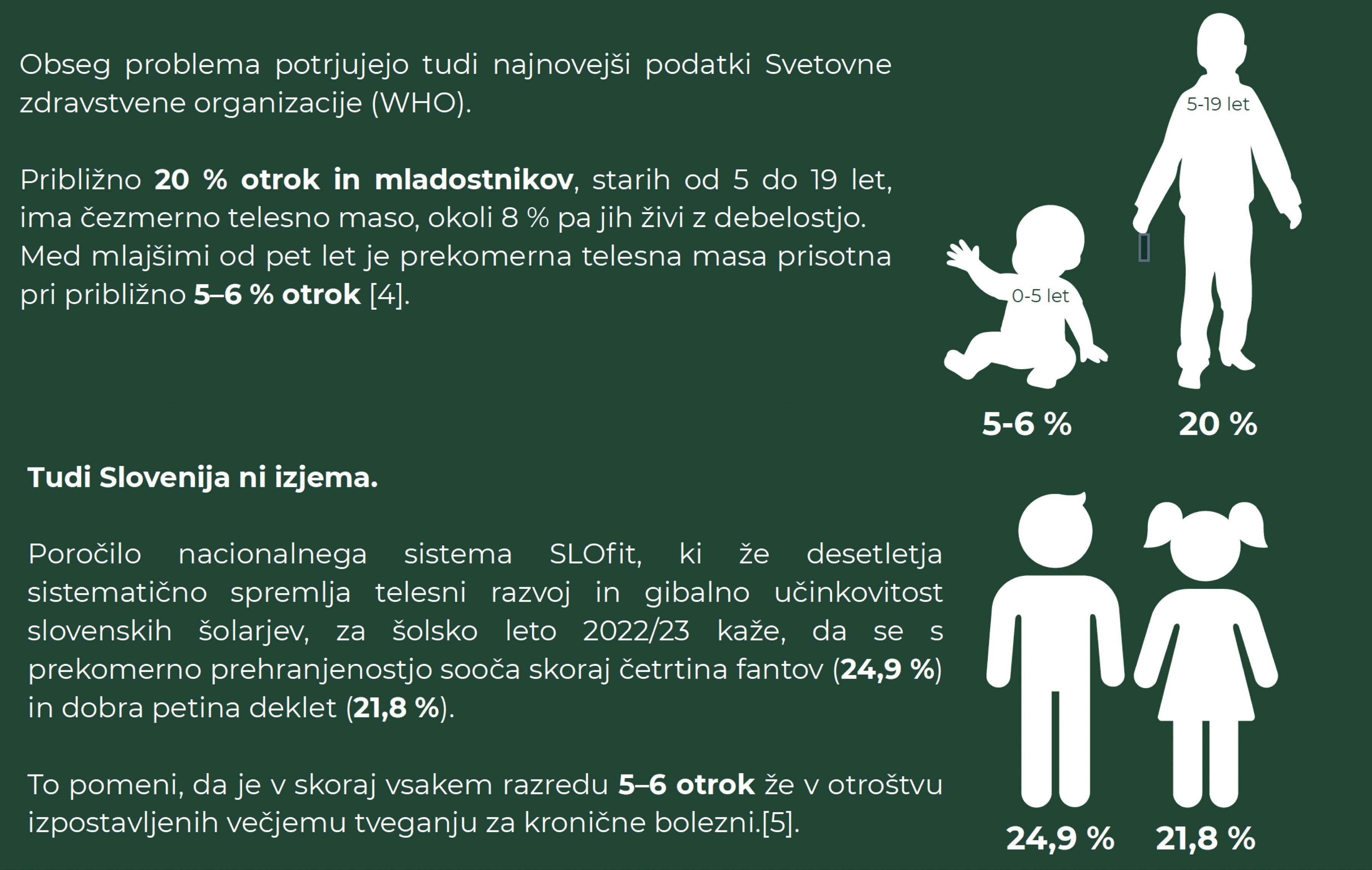
Slovenia is no exception either. The report from the national SLOfit system, which has systematically monitored physical development and motor efficiency of Slovenian students for decades, shows for the school year 2022/23 that nearly a quarter of boys (24.9%) and a good fifth of girls (21.8%) face overnutrition. This means that in almost every classroom, 5–6 children are already exposed to increased risk for chronic diseases in childhood [5].
Why Is Childhood a Critical Window of Opportunity?
Childhood is the period when fundamental dietary patterns are formed, which often persist into adulthood. In the first years of life, taste preferences, satiety perception, and the entire relationship with food develop. Children don't just learn which foods they like, but also what way of eating becomes a natural part of their daily routine [1].
If a child is regularly exposed to intensely sweet, salty, or fatty flavors from highly processed foods and sugary drinks, they gradually adapt to this flavor profile. Natural, less intense flavors of vegetables, fruits, or whole foods may therefore seem less appealing to them. Such rejection is often not the child's stubbornness but a consequence of learned dietary patterns formed through repeated experiences in the home environment.
Children often need 8–15 (sometimes even more) repetitions before they truly accept a new food as part of their diet [6]. This is why the early period is so important: dietary patterns are still adaptable, and new positive experiences with foods have an exceptionally long-term effect. Later in life, habits are already firmly established and changing them requires significantly more effort and time.
This developmental sensitivity of the early period requires a thoughtful approach to family nutrition, which is practically reflected in several fundamental principles.
5 Pillars of Building Healthy Eating Habits in Children
1. Adults as Role Models
Children form their eating habits primarily by observing adults. Research consistently shows that regular consumption of vegetables, fruits, and whole foods by parents is an important predictor of children's diets. The likelihood that a child will accept a particular food is significantly higher if it's regularly consumed by adults in the family.
Children observe what adults put on their plates, whether they eat vegetables without complaints, whether they eat slowly or hurry. They don't just adopt food choices but also the manner of eating and begin to imitate this behavior.
2. Regular Meals as the Foundation for Appetite Regulation
Irregular eating and skipping meals increase the likelihood of later overeating and more frequent selection of energy-dense snacks. A stable eating rhythm supports the development of internal hunger and satiety signals.
It's sensible to establish regular meals with intervals of approximately 2–4 hours. Between meals, children should consume only water or unsweetened tea, allowing hunger and satiety signals to develop naturally without interference from snacks.
3. Persist in Offering Not-Yet-Accepted Foods
Accepting new foods is a process, not an event. Research shows that children often need 8–15 repetitions before accepting a new food as part of their diet. The key is that exposure be calm and without forcing. A small amount on the plate, without conditions or rewards, allows gradual adaptation to new flavors.
Involving children in food selection and preparation increases their willingness to try new foods. Participation reduces resistance and increases the sense of safety around new tastes.

4. Implement the "5 a Day" Recommendation
Different colors of fruits and vegetables represent different groups of bioactive compounds, antioxidants, and micronutrients. The greater the color diversity, the broader the range of nutrients that support immune function, metabolic processes, and cognitive development.
The "5 a day" recommendation means that children consume at least five portions of fruits and vegetables daily, with vegetables predominating. It's sensible to aim for approximately three portions of vegetables and two portions of fruit, along with color diversity, as this reflects nutritional variety.
5. Limit Sweet Foods and Sugary Drinks
Sugary drinks, pastries, cakes, candies, chocolate spreads, and other sweet snacks often contribute significantly to energy excess in children's diets while not providing adequate nutritional value.
Sugary drinks are one of the most important dietary risk factors for excess body weight and obesity in children, as they enable high energy intake without appropriate satiety feelings.
Regular consumption of such beverages is also associated with increased risk of tooth decay.
Treat fruit juices, even those with 100% fruit content, as treats, not daily hydration. Water or unsweetened tea should become the basic beverages. Sweets and sugary drinks should be occasional parts of the diet, not daily habits.
The Future Doesn't Just Happen. We Build It.
Every meal is an opportunity. Every repetition of a new food is an investment. Every example at the table is a message that children carry into adulthood. Healthy eating habits in childhood are not just a momentary choice but the foundation of long-term health for individuals and society.
Therefore, parents in forming these habits should not be left to chance but should rely on verified information and professional support.
References:
1. Scaglioni, S., et al., Factors Influencing Children's Eating Behaviours. Nutrients, 2018. 10(6).
2. Zheng, M., et al., Dietary Intake Trajectories from Early Life and Associated Health Outcomes: A Systematic Review. Advances in Nutrition, 2025. 16(11): p. 100528.
3. OECD, The Heavy Burden of Obesity: The Economics of Prevention, OECD Health Policy Studies. 2019, OECD Publishing,: Paris.
4. WHO, Obesity and Overweight: Key Facts. 2025: https://www.who.int/news-room/fact-sheets/detail/obesity-and-overweight.
5. Starc G., K.M., Leskošek B., Sorić M., Jurak G., Poročilo o telesnem in gibalnem razvoju otrok in mladine v šolskem letu 2022/23 [Report on physical and motor development of children and youth in school year 2022/23]. 2023, Fakulteta za šport: Ljubljana.
6. Spill, M.K., et al., Repeated exposure to food and food acceptability in infants and toddlers: a systematic review. The American Journal of Clinical Nutrition, 2019. 109: p. 978S-989S.